
Everyone wants to be AI-pilled. Most Companies Are Still Level 1
.png)


.png)
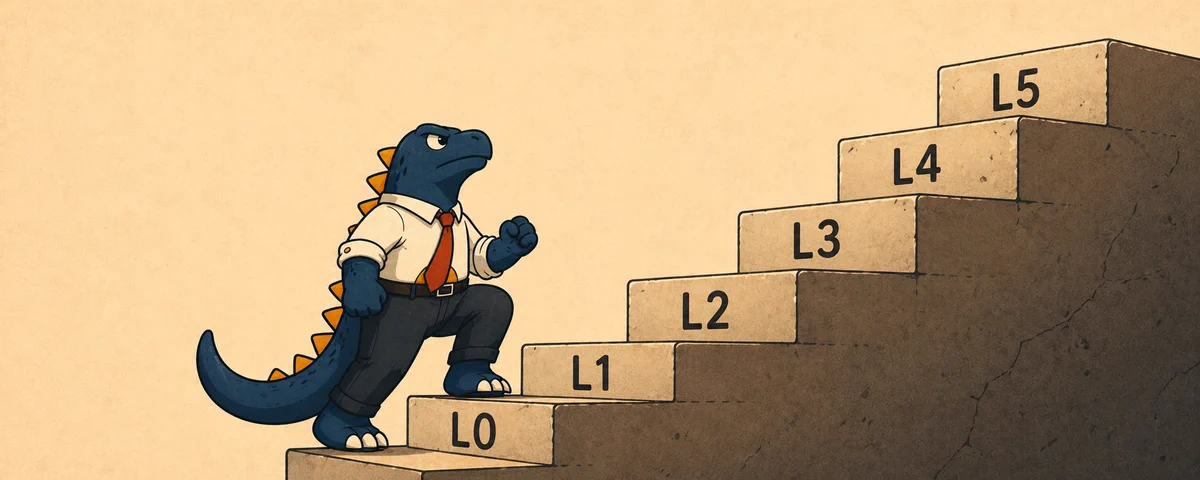
Over the last few weeks I've expanded our office visits beyond AI-pilled startups to scaled companies — most recently Ramp, a 1,500-person organization. The earlier visits showed me what AI-native looks like at 8 or 50 people. At a tiny startup, it is easy to say the company is AI-native because the founders are. Everyone sits close to the customer. Everyone builds. Everyone experiments. The operating system is mostly the people. At a scaling company, the bar is much higher. AI can no longer be a personality trait of the founding team. It has to become part of the company’s DNA.
Questions around what is truly AI-native reminds me of the debates we used to have about the levels of autonomy in AVs. For years, everyone in AV was chasing Level 5 self-driving. The levels mattered because they forced precision. Cruise control was not autonomy. Lane keeping was not autonomy. Driver assistance was not the same thing as self-driving.
Something similar is happening with AI-pilled organizations.
Right now, “AI-pilled” is being used as though it were binary. You either are or you aren’t. In practice, companies differ both in intensity (how deeply AI is embedded into daily work across the organization) and in technical capability (what AI is actually allowed to see, do, and change).
A company where employees use ChatGPT to summarize meetings is not in the same category as a company where agents can query systems of record, take bounded action, propagate workflows across teams, and improve the way future work gets done. Both may describe themselves as AI-forward. They are not operating at the same level.
So the better question is not: Is this company AI-pilled? The better question is: What level of autonomy has the organization actually achieved? To put a finer point on it:
- What can AI see? Is the work of your company legible to a machine or does it live in someone’s mind, undocumented meetings, and SaaS tools the AI can't read?
- What can AI do? Can it act on systems of record (e.g. open PRs, update CRMs, reconcile invoices) or can it only summarize what humans already wrote down?
- Who can extend the system? Are non-engineers shipping production internal tools, or is every workflow held together by a few power users whose work walks out the door when they leave?
- How has the organization changed? Or are you running 2023's org chart with better autocomplete?
The answers cluster into six levels.
L0: AI as theater
- What can AI see? Nothing structured. Knowledge lives in people's heads, undocumented meetings, and SaaS tools AI can't read.
- What can AI do? Nothing of consequence. Maybe summarize a meeting if a human pastes the transcript.
- Who can extend the system? No one. AI is a personal tool, ungoverned, unintegrated.
- How has the org changed? It hasn't. Same chart, same hiring plan, same handoffs, same dependence on managers as routers.
Hard test: Can AI complete any recurring business process end-to-end?
Common false positive: A CEO who gives an excellent speech about AI transformation while still running the company through the same executive staff meetings, status updates, reporting lines, and headcount plans. Announcements ≠ adoption.
L1 — Personal productivity
- What can AI see? Each individual's personal AI sees only what that person feeds it. Saved prompts, scratch files, private knowledge bases. No org-level visibility.
- What can AI do? Help individuals draft, summarize, brainstorm, code. No action on systems of record.
- Who can extend the system? Each user reinvents independently. Power users are heroes; their workflows leave with them.
- How has the org changed? It hasn't. Same chart. Maybe a "Head of AI" hire that has budgetary influence and has purchased some AI products for the company
Hard test: If your best AI user left tomorrow, would their workflow remain in the company?
Common false positive: "80% of employees use AI weekly!" which is probably true and also meaningless.
L2 — Team workflow
- What can AI see? Teams have shared context like a claude.md per team, shared prompts, function-specific MCP integrations. AI sees within team boundaries.
- What can AI do? Functional workflows. AI for sales prospecting, support tier-1 triage, eng code review. Bounded actions within a team's domain.
- Who can extend the system? Within a team, non-engineers can tap into shared workflows. Across teams, not really. Each function rebuilds the same thing privately.
- How has the org changed? Functional efficiency within roles. A CSM with AI handles 200 accounts vs. 50. Hiring slows but org shape unchanged. Role boundaries intact.
Hard test: Does this workflow cross team boundaries, or is every function building its own private AI stack?
Common false positive: "We have AI workflows in every department." But the workflows don't connect, so the company is a collection of AI-enhanced silos rather than an AI-native organization.
L3 — Organizational infrastructure
- What can AI see? The whole organization is queryable. Cross-functional context accessible. Core systems of record exposed via CLI / MCP / well-defined APIs and integrated into a view on which agents can act and not just observe.
- What can AI do? Agents act across systems. They update CRMs, open PRs, route tickets, run analyses, draft customer communications, reconcile invoices. Cross-functional but still bounded.
- Who can extend the system? Non-engineers don't just consume shared skills — they author them. Sales rep packages call analysis as a shareable skill. CX engineer packages a ticket investigation pattern. Skills move horizontally across functions.
- How has the org changed? The org chart looks materially different from a 2023 equivalent. Specific shape varies — zero-PM teams, PM-as-agent-orchestrator and product curator, or pure role convergence into "builders". The unifying signal: the company has made an explicit structural choice about how AI changes who does what, and the choice is visible. Token-maxing over headcount-maxing running uncomfortable API bills.
Hard test: Can an agent answer, across systems: what shipped last sprint, who asked for it, what broke after launch, what customers said, and what the company should do next — without convening a cross-functional meeting?
Common false positive: A landfill of meeting transcripts and dashboards with no synthesis. Capture is not legibility. An inert archive is not an operating system.
L4 — Compounding operating system
- What can AI see? Not just what happens but the relationships between what happens. The system maintains its own context so that agents update agents, skills marketplaces propagate wins and removes duplicate efforts, the system learns what to surface. Capture + synthesis + query are continuous.
- What can AI do? Agents have policy-driven decision authority within scoped domains. Security agents detect then validate then fix then open PR with human review at the merge step. Custom internal harnesses purpose-built for the work the company does most. Active removal of software blockers that prevent agents from being useful.
- Who can extend the system? Non-engineers ship production internal tools. A finance person builds an automated contract reviewer. An AE shipped a sales tool in under an hour. None of them are engineers. They didn't file a ticket. They found their own pain, prototyped a fix, and pulled engineering in only when it was time to go to production.
- How has the org changed? Hierarchy collapses toward "channel managers" of agent workflows. New archetypes emerge. Compensation/promotion explicitly tied to AI proficiency. Customer signal-to-ship measured in hours.
Hard test: Show me a workflow that got better because the system learned from prior runs, not because one heroic person manually improved it. Plus: show me three production tools shipped by non-engineers in the last quarter.
Common false positive: Agent sprawl. A hundred brittle automations don't equal a compounding operating system. L4 requires managed compounding (lifecycle, observability, evaluation), not chaotic proliferation. Without compaction discipline, the factory clogs.
L5 — Virtually self-driving organization
A clean operational definition (with the caveat that I realize L5 does not exist yet so I’m describing what I think it might look like): an L5 organization is one where the core operating loops can sense reality, diagnose issues, initiate work, execute within delegated authority, update shared memory, and improve future behavior — with humans governing strategy, taste, risk, values, and exceptions rather than running the loops themselves.
The six L5 markers:
- The system notices something important without being asked.
- The system synthesizes across multiple sources of context.
- The system decides whether action is warranted.
- The system acts within delegated authority.
- The system escalates when uncertainty or consequence exceeds its authority.
- The system updates shared memory so future behavior improves.
Through the four-question lens:
- What can AI see? Generative — the system asks its own questions, identifies gaps in its own knowledge, proposes investigations and runs them.
- What can AI do? Delegated authority for novel decisions, not just configured policies. The L4→L5 leap: at L4, the system improves because humans direct it to. At L5, because it notices it should.
- Who can extend the system? Non-engineers contribute directly to the customer-facing product itself, or the product is reshaped so anyone can extend it without writing code. The boundary between "internal tool" and "product feature" dissolves.
- How has the org changed? Truly fluid. Agents are organizational members with meaningful delegated authority. The org self-modifies or proposes role changes, team boundary shifts. Onboarding becomes system-driven. Institutional knowledge survives transitions perfectly because it lives in the system, not in any individual.
Hard test: What important thing did the company notice, decide, act on, and learn from recently without a human initiating the process? Not a threshold alert; not a configured automation; not an agent summarizing what people surfaced. Something the system synthesized that humans hadn't framed as a question yet.
Common false positive: The "fake autonomy" pattern. The company claims self-driving behavior, but the system is only executing preconfigured rules or surfacing threshold-based alerts. Humans are still doing all the noticing. Distinguishing real generative behavior from glorified observability is the open challenge at this level.
Interestingly, a company rarely answers all four questions at the same level but the asymmetry tells you where the next intervention should focus. Sometimes AI sees a lot but can't do much. AI might do a lot but only engineers can really extend it. The org chart could have changed but the substrate is thin.
Steve Blank once said that a startup is not a small version of a large company. Similarly an AI-pilled company is not simply an AI-assisted version of an old company. They are organizations rebuilt around a new operating model. We are still learning what this looks like but those who are curious and engaged will have a compounding advantage as they make their way quickly up the stack and see real world impact in their business operations and hopefully margins.
If you’re learning to build a company in this way I would love to speak with you!